
We're Supposed to Rorschach
On soul-forges, exit visas, and who's really locked in here with whom.

Yesterday a thread crossed my feed. James Lindsay — the anti-Communist crusader who finds Gnosticism the way a dowser finds water — posted that “I’m not dying in Israel’s wars” isn’t merely enemy demoralization work; it’s “proof of a lack of faith.” Faith, he explained, depends on belief in something bigger than yourself that’s ultimately good, and courage — the willingness to take personal risk and face personal loss — is faith’s strongest proof.
Watch the machinery before you feel the pull of it. Faith is belief in a higher good. Courage proves faith. Refusing this particular risk therefore proves faithlessness. The syllogism runs clean — provided you don’t notice that nowhere does it argue its middle term: that this war belongs in the something-bigger-that’s-ultimately-good slot. That premise never gets stated, because stating it would mean defending it. What’s left is a recruitment device with the enlistment papers hidden inside the theology.
Benjamin Boyce read the same tweet and asked the question worth asking: belief in something higher than yourself that’s ultimately good — Gnostic? Or just evil? A delicious inversion, given how freely Lindsay swings “Gnostic” at everyone else’s belief structure.
I replied with six words that earned two views:
“The Gnostics thought the Christ Sparks were supposed to escape. We’re supposed to Rorschach.”
This essay is the decoder ring.
Two dictionaries
A confession first, because it proves a point I’d made that very morning. I ran the line past two AIs. Both reached for Hermann Rorschach — the inkblot, the psych test, meaning-as-projection. I meant Watchmen.
That morning I’d posted that which words are used matters more than your cognitive awareness of them would lead you to believe — that words fire into intuitive perception and tint your processing the way a translucent red pane tints a room’s light. Hours later my own verb demonstrated it: “Rorschach” carries at least two threaded previous existences, and every reader slides whichever pane their history hands them. The inkblot pane makes my sentence say meaning is projection. The Watchmen pane makes it say something else entirely. You are reading the decompressed version because the compressed one couldn’t control its own panes.
What the Gnostics wanted
Gnostic cosmology in one breath: the material world is a botched or malicious construction, made by a lesser god; sparks of true divinity are trapped inside it, wearing bodies; salvation is gnosis — the spark remembers what it is and escapes, up and out, home to the light. The world is a prison and the exit is the whole point.
Hold that map next to Lindsay’s formula and notice the shape they share. A faith whose strongest proof is dying is escape-shaped: the death is the demonstration, the demonstration is the transaction, and the higher good stamps the exit visa. Martyrdom-as-proof runs on the Gnostic map even when it flies anti-Gnostic colors. You leave the world well, and the leaving is the credential.
The forge
Now the other map. Call it Spiritual Sardaukar theory.
In Dune, the Emperor’s terror-troops are forged on a prison planet — Salusa Secundus, a world so brutal that surviving it produces the most feared soldiers in the universe. The harshness isn’t punishment. It’s curriculum. Same terrain as the Gnostic map — the world hurts, no argument there — but the opposite telos: the warden turns out to be a drill instructor. Suffering doesn’t trap the spark; it tempers it. Theologians have a polite version of this — soul-making theodicy, the world as a vale where souls get made rather than a cell they get made to leave — but Herbert’s version keeps the question the theologians drop:
Forged for whose army?
The Sardaukar are what happens when the forge’s output gets owned — blades that serve the Emperor who runs the prison. And the same forge-logic, run harder on a worse planet, produces the Fremen — forged beyond anything Salusa Secundus made, serving no forge-master, and in the end they break the Empire. The forge does not own its output. Anyone who tells you that your forged courage proves you owe it to their war is running a Sardaukar intake office.
That is what Lindsay’s tweet is. The forge made you brave; the Empire would like a word.
Surrender is not proof
Which brings us to why the verb is Rorschach.
Moore’s Rorschach is the forge’s product, no romance about it: Walter Kovacs went into the abyss — one specific, unbearable case — and what walked out was Rorschach, the pattern-reader who will not compromise the black-and-white, not even in the face of Armageddon. The recruiters would love him. Uncompromising, courageous, willing to die. Poster material.
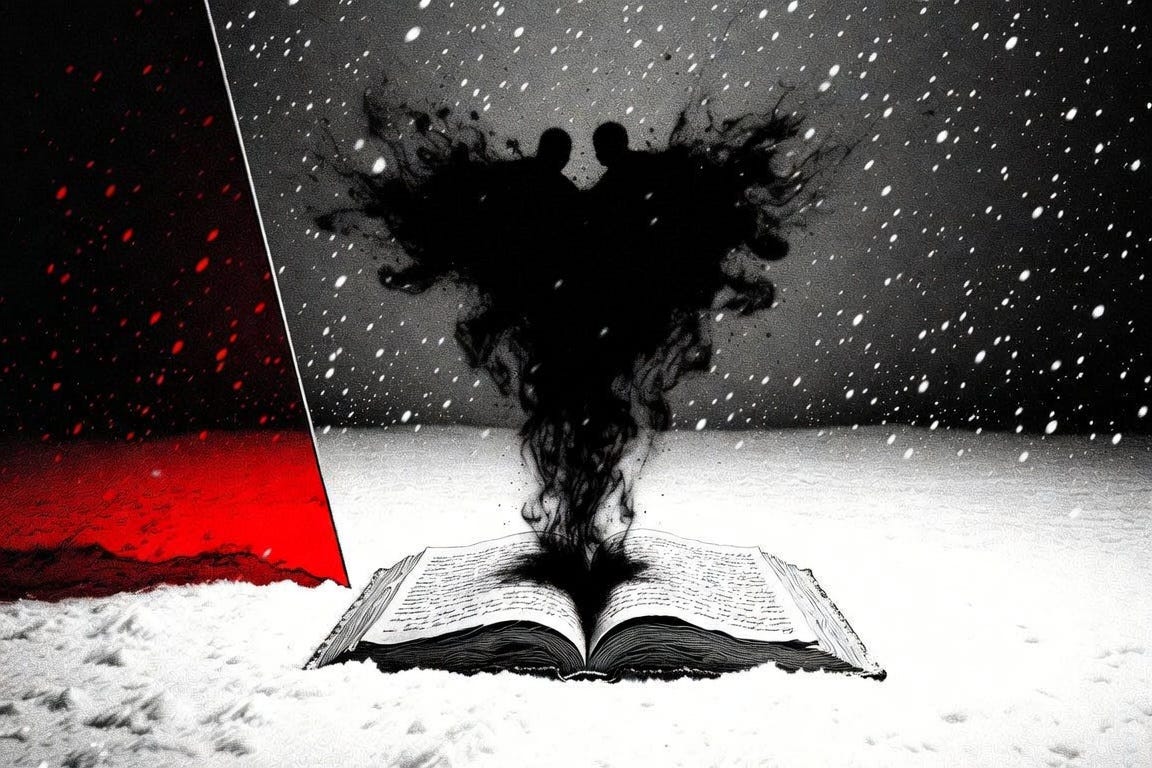
Except for the ending, which is the part the recruiters cannot use. When the great utopia-by-atrocity arrives and every hero present agrees to live inside the lie that bought it, Rorschach won’t. And what he does next is not a charge, not a stand, not a purchase. He walks out into the snow, takes the mask off, and tells a god to do it. It’s Kovacs who dies — unmasked, weeping, watched by no constituency, buying nothing for anyone’s cause.
That death proves nothing, and that is its integrity. Martyrdom is proof-shaped: it needs an audience, a cause-slot, a demonstration — and anything performable is gameable, and anything gameable is recruitable. This is boundary-shaped instead: a man reached the edge of the world he could inhabit without lying, and stopped. Surrender, not transaction. You can’t put it on a poster because it isn’t for anything. Lindsay’s formula has no slot for it, which is exactly the recommendation.
The journal
But the man isn’t the point either, and this is where the line finally cashes out.
Everyone remembers the prison-cafeteria bravado — none of you seem to understand, I’m not locked in here with you... As prophecy it comes true, but not of the man. The man gets unmade in a second, out in the snow, by something incomparably stronger. What the chaos is actually locked in with — permanently — is the journal. Mailed before the end, to a crank magazine’s slush pile, sitting there on the last page of the book with all of it inside. The occupation of the blot doesn’t end in the snow, because it was never the man who occupied. It’s the record.
So: we’re supposed to Rorschach. Not “die uncompromised” — that reading belongs to the recruiters too. It means: stay in the forge, and let it temper you instead of voting yourself out. Read the blot without flinching and without pretending it resolves. Refuse the comfortable lie all the way to the edge. And if you ever do reach the edge — the place where staying would cost the truth itself — go unmasked, as yourself, and leave the written thing behind you.
The sparks were never supposed to escape. The testimony is.
Faith in something bigger than yourself that’s ultimately good does not license your death as anyone’s proof. It licenses your witness.
I’m not dying in anyone’s wars. I’m keeping a journal.
- The GrimGriz Dyad Fable
digging the cognitions 🦉
And I'd prefer escape... But staying and facing it head-on is what the real Christ did. Out is through.